![AI Tinkerers Houston: May 5th Meetup [AI Tinkerers - Houston]](https://sloppy-joe-app.imgix.net/ai_tinkerers/logos/ai_tinkerers_-_houston_laptop-sticker_190_b1536b385673e13fdaaa2ef580f25883.png?w=300&fit=max&auto=format%2Ccompress&q=75)


AI Tinkerers Houston: May 5th Meetup


AI Tinkerers Houston: May Meetup
The Houston builders’ network convenes for an evening of technical deep dives and live demonstrations. This is a curated gathering for engineers, researchers, and founders who are actively shipping software using foundation models and generative AI.
We prioritize raw, technical demos over polished marketing pitches. If you are navigating the shift toward agentic workflows, high-efficiency local execution, or long-context orchestration, this is where you connect with peers solving similar constraints.
Event Details
- Date: Tuesday, May 5, 2026
- Time: 5:30pm – 8:00pm CST
- Location: Houston, TX (Address revealed to accepted attendees only)
- Capacity: 150 builders maximum
Space is limited and curated. Registration is open now.
Call for Demos: Show Your Work
AI Tinkerers is about showing what you’re building. We are looking for practitioners to share their technical discoveries, stack implementations, and hard-earned lessons. Skip the slides and show us the code.
We are particularly interested in seeing:
- Agentic Workflows: Implementations leveraging GPT-5.4 Mini or Codex Background Computer Use for autonomous navigation.
- High-Efficiency Inference: Use of TurboQuant or 1-bit quantization (Bonsai 8B) for local execution.
- Long-Context Systems: Complex workflows utilizing the 1M token window in Claude Opus.
- Multimodal Applications: Low-latency vision and audio processing with Gemini 3.1 Flash Live.
Submit Your Demo Proposal Here
Curation and Attendance
AI Tinkerers is selective by design to maintain a high-trust environment for candid technical exchange. Every attendee is vetted. We require demonstrable proof of your active involvement in AI/ML building (GitHub, LinkedIn, or Twitter links).
This event is for practitioners who can pop the hood and share their stack. It is not for recruiters, marketers, or consultants.
🎤 Featured Builders
🥽 Speakers
The Intelligent Light Fixture

Kieran Skelly
founder @ GridLights
🧪 Science Fair & Networking
During our networking hour, we feature a “Science Fair” format. This allows for decentralized, hands-on technical discussions where you can walk through code and experimental implementations that might not be on the main stage.
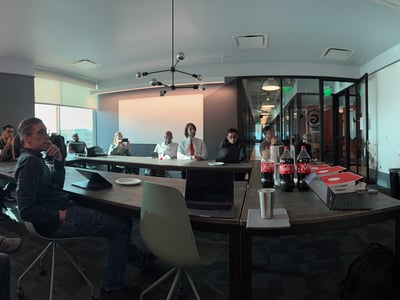
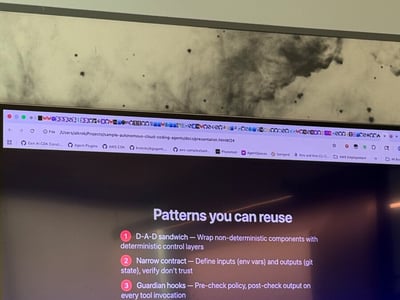
Event photos
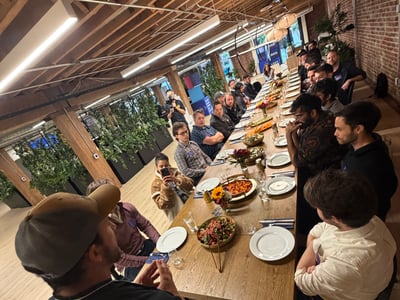
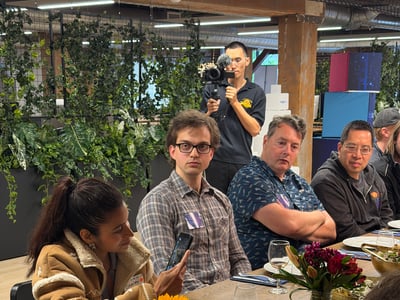
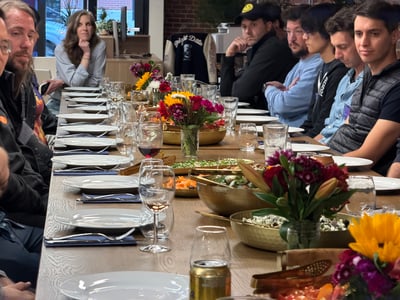
Honoring Our Partners
AI Tinkerers is a global community of over 100,000 engineers, researchers, and founders dedicated to the technical art of building with generative AI. With active chapters in 214 cities, the group hosts monthly meetups centered on technical depth and peer-to-peer knowledge sharing. Every session features live code demonstrations from local builders, strictly prohibiting slides or sales pitches.

Interested in supporting the Houston builders’ network? We only partner with brands that ship. Learn about sponsorship opportunities here.
📊 AI Tinkerers Houston Stats
- Attendees: This community of 219 active builders comprises 45% AI/ML engineers, 35% full-stack developers, and 20% data architects. Notable for bridging generative AI with Houston's energy and healthcare sectors, members represent organizations like ExxonMobil and Meta. The group stands out for its high concentration of technical founders and specialists actively deploying autonomous agentic workflows and custom LLM integrations.
- Companies Represented: Featuring tech giants and platforms like Meta, Amazon Web Services, Oracle, and IBM, alongside industry leaders such as Searce, Chevron, C3.ai, and Diffbot, and emerging startups like EvolutionIQ, Copilot Search, Radial AI, and theFLO.ai, and more.
- Demos: 19 demos have been submitted and presented, with strong recurring themes around agentic and autonomous workflows, reliability-focused LLM integration (structured data, hallucination control, and deterministic execution), and cost/performance-aware orchestration using caching and efficient model setups. Exciting technical areas have also included local-first private AI, multimodal document/image intelligence, blockchain-enabled automation, and simulation/performance techniques such as WASM rendering and optimized inference.
- Testimonials:
A great demo follows a strict show-and-tell ethos: skip the slides, but make the work visible by running code, showing the full end-to-end workflow, and highlighting the concrete engineering choices that make it work (and remain stable). In the highest-rated examples, speakers earned praise by delivering dense technical content without dragging, creating “builder-to-builder” conversation, and making internals understandable—architecture, constraints, and reliability mechanisms—rather than vague promises. To avoid the common failure modes seen in the weaker presentations, don’t rely on gated/empty pages, missing technical detail, or unverifiable claims; attendees respond when they can infer exactly what you built, how it operates, and what other builders can reuse or avoid. In general: demonstrate the working artifact, narrate the hardest parts of the build loop, call out failure modes and tradeoffs, and keep the demo centered on code and outcomes that others can learn from directly.
In Houston, [Autonomous background coding agents] by Alain Krok earned a perfect 5/5 average (4 ratings) with attendees calling it “Great content. Information dense without dragging” and noting they kept talking about it after the talk—suggesting the audience valued an engaging, technical forward-looking explanation with substance despite not being slide-heavy. Another strongly liked demo is [The Intelligent Light Fixture] by Kieran Skelly, also very highly rated (4.8/5), where feedback focused on the concrete technical feat: “3D rendering running in the browser via 20k lines of C compiled to WASM,” alongside curiosity about the underlying hardware/software direction (“eager to talk ESP32 dev”). For orchestration and engineering rigor, [Building a Terminal Orchestrator for AI Coding Agents in Rust] by Silviu Nedea is notable for the kind of system depth that audiences typically reward—named components, verification gates, and long-term pattern learning—making the build plumbing legible and actionable for builders.